The 2014 FIFA World Cup in Brazil entered history books not only for high-scoring matches and dramatic upsets, but also for its centerpiece: the Adidas Brazuca. Four years earlier, the notorious Jabulani ball used in South Africa became a public relations disaster for Adidas and FIFA. Strikers complained it moved like a beach ball, while goalkeepers dreaded its unpredictable "knuckling" behavior in mid-air. When Adidas introduced the Brazuca for the Brazilian tournament, it faced intense skepticism. Yet, the six-panel design fundamentally changed how modern footballs are engineered, tested, and perceived by elite athletes.
Search intent for this topic focuses on understanding how the Brazuca solved the aerodynamic failures of its predecessor, why its construction differed so radically from traditional balls, and whether the controversies surrounding it held any real weight. Most existing accounts skim past the precise wind tunnel mechanics and the internal sensor data that made this tournament a milestone for sports tech. Below, we break down the engineering choices, player trials, and manufacturing realities that defined the 2014 World Cup match ball.
The Aerodynamic Crisis: Why the Jabulani Forced a Redesign
To understand why the Brazuca mattered, you have to look at the backlash from the 2010 World Cup. Traditional soccer balls relied on 32 geometric panels stitched together. The 2010 Jabulani reduced that count to eight spherically molded panels, joined with thermally bonded seams instead of thread. While this created a perfectly round, waterproof sphere, it also eliminated surface roughness.
In fluid dynamics, a completely smooth sphere experiences erratic airflow transitions at medium speeds (around 30 to 50 mph). This causes the ball to experience sudden, unpredictable lateral forces—known as knuckling—where it shifts sideways without spinning.
Adidas and researchers at Loughborough University realized they needed to reintroduce controlled surface roughness without compromising the spherical shape. The Brazuca tackled this by increasing the total length of the seams and adding a distinct, pebble-like texture across every panel. This forced the boundary layer of air to transition from laminar to turbulent flow much earlier in its flight path, stabilizing the trajectory and drastically cutting down on wild, random swerves.
Anatomy of the Brazuca: Six Panels and Thermal Bonding
The physical structure of the Brazuca broke conventional manufacturing rules. Instead of traditional hexagons and pentagons, the shell consisted of six identical, propeller-shaped polyurethane panels.
- The Shape: Each panel resembled a curved cross or blade, interlocking with adjacent pieces to form a continuous sphere.
- The Seams: By reducing the total number of panels to six, the total seam length increased significantly compared to the Jabulani, creating deeper and longer grooves across the surface.
- The Texture: Every panel featured a micro-texture of tiny bumps, which mimicked the aerodynamic properties of a traditional textured leather ball while maintaining modern synthetic durability.
- Internal Bladder: Beneath the polyurethane outer shell lay a multi-layer cushioning foam carcass and a high-retention rubber bladder designed to maintain air pressure and water resistance through torrential tropical downpours.
This construction ensured that moisture absorption was kept to a minimum. In wet conditions, the Brazuca absorbed virtually no water weight—a massive upgrade from older leather balls that grew noticeably heavier in the rain.
Unprecedented Testing: Over 600 Players in the Lab
Adidas knew they couldn't rely solely on wind tunnel computers. Before the ball ever touched grass in Rio de Janeiro, it underwent a two-and-a-half-year testing phase across three continents. More than 600 professional players and thirty teams put prototypes through grueling trials.
Testing squads included powerhouse clubs like AC Milan, Bayern Munich, and Palmeiras, alongside national team icons like Lionel Messi, Dani Alves, and Iker Casillas. Unlike past developments where players received finished products just weeks before a tournament, this feedback loop happened iteratively. When players noted that the early prototypes felt too slick on long crosses, engineers adjusted the surface grain depth. When others requested a softer touch for chest-trapping, the foam backing density was modified.
This collaborative development smoothed out potential player complaints before the tournament began, ensuring that when the opening whistle blew in São Paulo, the athletes were already familiar with how the ball would leave the foot.
Performance on the Pitch: Strikers vs. Goalkeepers
When the tournament kicked off, the on-field results vindicated the engineering team. The total goal tally reached 171, tying the record set in 1998, and long-range strikes became a hallmark of the group stage.
Strikers enjoyed reliable trajectory on curling free-kicks and blistering long-range drives. Because the turbulent airflow triggered predictably, players could impart heavy spin and trust that the Magnus effect—the force that curves a spinning ball—would act consistently.
Goalkeepers, who usually bore the brunt of modern ball designs, offered largely positive reviews compared to their trauma from the Jabulani. While shots still traveled at immense speeds, shot-stoppers could read the flight path early. The ball didn't dip or dart away at the last second, allowing for cleaner catches and more accurate parrying.
The Smart Ball Innovation and Goal-Line Tech
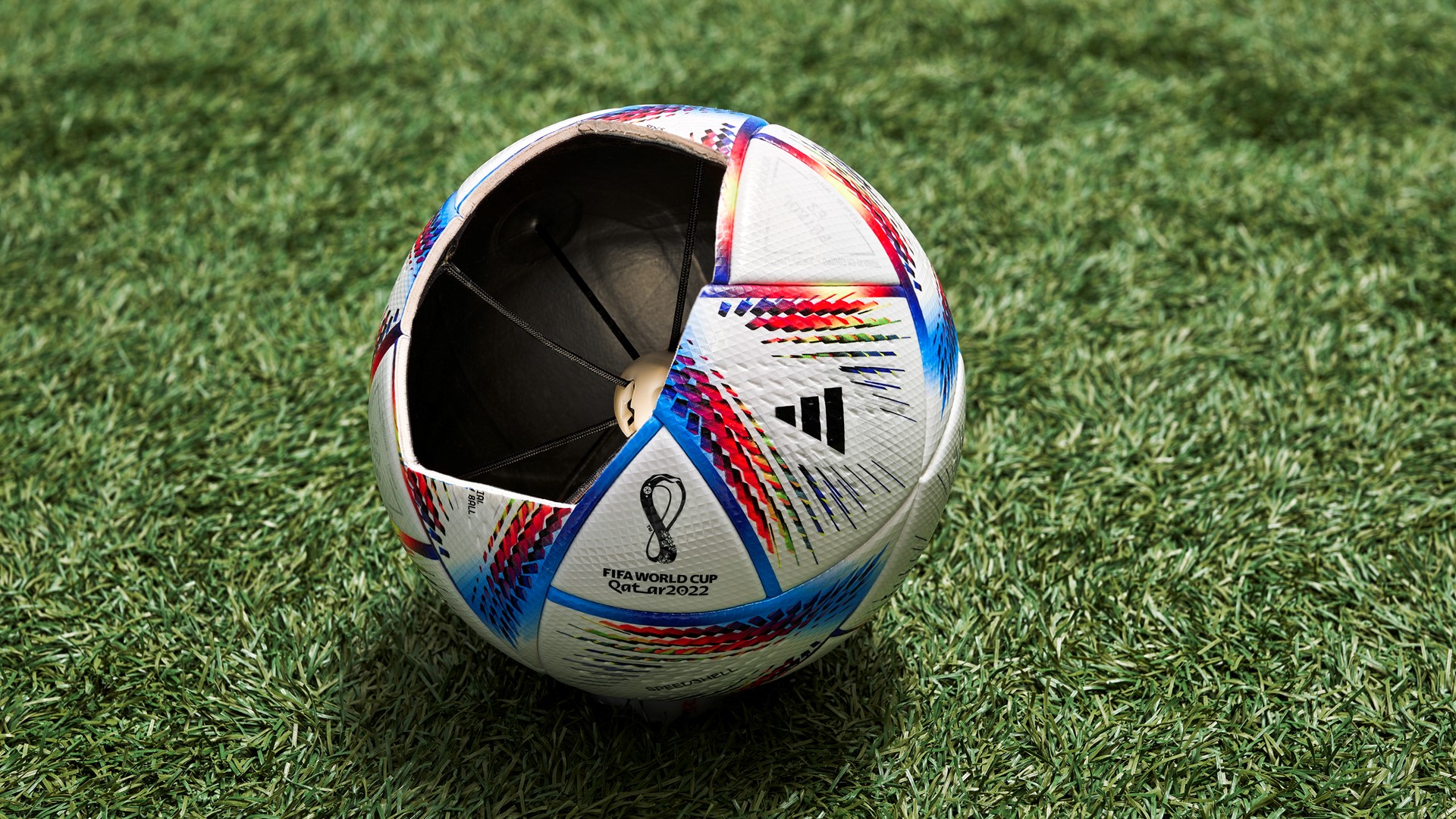
Beyond aerodynamics, the Brazuca served as a pioneer for data integration. Inside the core of select match balls sat a customized sensor unit developed in partnership with Fraunhofer Institute for Integrated Circuits.
This sensor tracked velocity, rotational speed, and precise coordinates within millimeter accuracy, communicating with stadium-mounted high-speed cameras 500 times per second. While players couldn't feel the sensor during normal play, it acted as the silent partner for GoalControl goal-line technology. When disputes arose over whether a ball had fully crossed the line, the system processed the sensor and camera data instantly, relaying a definitive verdict to the referee's wrist-mounted receiver in less than a second.
Common Misconceptions About the Brazuca
Despite its success, sports media and fans frequently misunderstand several aspects of its legacy:
- Myth: The Brazuca was identical to the balls bought in retail stores.
- Reality: While consumer replicas shared the visual design and six-panel layout, the official match balls used heat-bonded professional carcasses with heavier bladder systems designed for elite turf use.
- Myth: It completely eliminated unpredictable movement.
- Reality: Physics dictates that any sphere moving through air will experience some degree of aerodynamic drag and side-force. The Brazuca minimized erratic knuckling, but hard-struck knuckle-balls still moved dynamically.
- Myth: It was universally praised without any complaints.
- Reality: A small number of players, notably from the Chilean national team during early group matches, publicly criticized the ball's grip on wet grass, proving that personal preference always plays a role in professional equipment.
Frequently Asked Questions
Why was it named the Brazuca?
The term "brazuca" is an informal local expression used by Brazilians to describe national pride, lifestyle, and the vibrant way of life in their country. The name was chosen via a public voting campaign in Brazil months before the tournament started.
How did the Brazuca compare to the 2010 Jabulani?
The Jabulani had only eight smooth panels and was notorious for erratic flight paths and unpredictable movement. The Brazuca used six textured panels with deeper seams, which created consistent turbulent airflow and stabilized the ball's trajectory in flight.
Did the Brazuca absorb water in the rain?
No. Thanks to its thermally bonded seams and advanced polyurethane outer skin, the Brazuca maintained near-zero water uptake, weighing virtually the same in heavy rain as it did in dry conditions.
Is the Brazuca still used in professional leagues today?
No. Match balls evolve for every major tournament cycle, with Adidas introducing newer models for subsequent World Cups and European Championships that build upon the aerodynamic lessons learned from the Brazuca's six-panel breakthrough.



